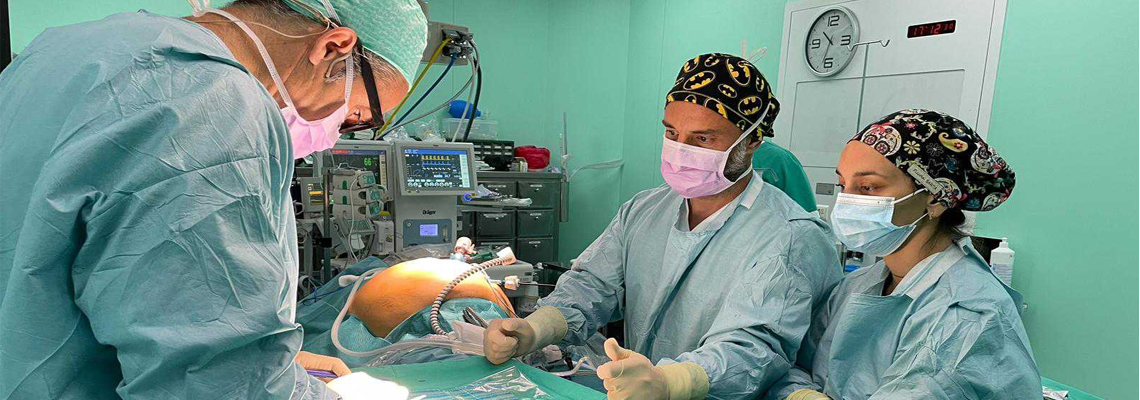
On July 19, the General and Digestive Surgery Service of the Hospiten Sur University Hospital held a conference on E-TEP/TEP-RS laparoscopic repair of ventral hernias. The conference, directed by Dr. Fernando Estevez de la Rosa, general and digestive system surgeon at the center, was attended by Dr. Juan Bellido Luque, assistant surgeon at the Laparoscopic Unit of the Virgen Macarena University Hospital in Seville and surgeons from the General and Digestive System Surgery Service at the Hospiten Sur University Hospital.
The conference was aimed at general and digestive system surgeons and included a theoretical part, a presentation of clinical cases and closed with three interventions in the surgical area, which the attendees were able to follow live via closed circuit television.
Dr. Juan Bellido Luque emphasized that "the main advantage of this new technique is that it uses a minimally invasive approach for the correction of eventrations in the middle abdomen, together with rectus diastasis". Therefore, "we correct both pathologies at the same time. We use conventional polypropylene meshes without any type of traumatic fixation, as is usually used in laparoscopic surgery," he assures.
Dr. Fernando Estévez de la Rosa, general and digestive system surgeon at the Hospiten Sur University Hospital, pointed out that the objective of the conference was to approach a laparoscopic abdominal wall technique, where its main indication is in the correction of ventral hernias, with certain characteristics that are usually associated with diastasis of the rectum.
The specialist assures that "it provides the patient with a reduction of pain, a better vision and correction of the defect, and a much earlier return to normal working life".
"This procedure is recommended for all those patients who have a midline wall defect, either in the infra or supraumbilical area, and it is usually indicated in primary or secondary hernias that are not very large," he indicated.
"The important thing is that it is a surgery with very little tissue damage. That is to say, the accesses are five and eleven millimeters and trocars are used, cylinders through which the material for the intervention is introduced. It is a minimally invasive laparoscopic access, and as a result of this, functional recovery is much faster, and the side effects and the need for postoperative analgesia are very low," the surgeon concluded.
Dr. Gianluca Cherubino, head of the General and Digestive Surgery Service at the Hospiten Sur University Hospital, assures that they have more than 20 years experience in Abdominal Wall Surgery, with the support of the latest technology and offering the most advanced techniques. "This conference is a great step forward in our objectives and we hope to hold sessions like this one every year, with the collaboration of the best specialists in the field," he concludes.
This article is an English translation generated with Al from the original Spanish content. While we review content for clarity, the information is provided for general informational purposes only and should not be considered medical advice. Always consult a qualified healthcare professional for diagnosis or treatment.