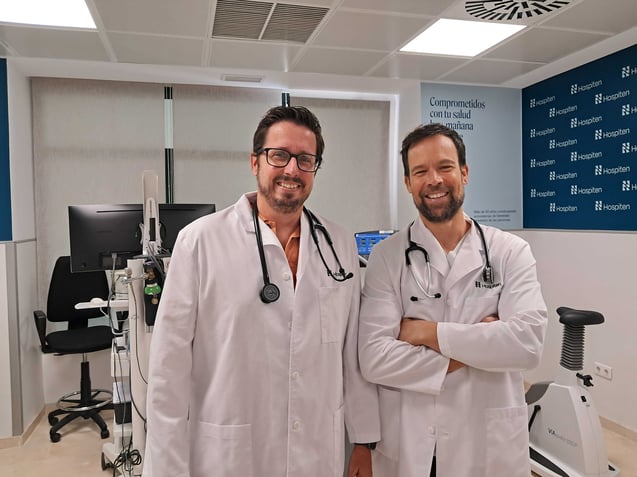
On the occasion of World Congenital Heart Disease Day, which will be commemorated on February 14, Hospiten highlights the importance of prenatal diagnosis of this group of diseases, a key advance that makes it possible to detect cardiac malformations before birth and plan their treatment in advance.
Congenital heart defects are malformations of the heart or large vessels that are present from birth. It is estimated that they affect approximately eight out of every 1,000 live newborns, making them the most common congenital malformation.
Dr. Carlos Rubio-Iglesias, specialist in Pediatric Cardiology at the Hospiten Rambla University Hospital, explains that "they originate during embryonic development, generally in the first eight weeks of gestation, when the cardiac structures are formed". He adds that "their spectrum is very broad: it ranges from mild defects, which resolve spontaneously and are of no health significance, to complex malformations that require surgery in the first days of life".
Quality of life and change in prognosis
Until the mid-20th century, many of these pathologies were lethal in infancy. However, thanks to advances in prenatal diagnosis, neonatology, cardiac surgery and specialized follow-up, the prognosis of these diseases has changed dramatically, so that today most children with congenital heart disease in developed countries reach adulthood.
In this context, Dr. Javier Fernández Sarabia, specialist in Pediatric Cardiology at Hospiten Bellevue and Hospiten Sur University Hospitals, affirms that "we are no longer talking only about survival, but about quality of life, social integration and aging with congenital heart disease".
This change has given rise to a new reality: adults with congenital heart disease outnumber children with these pathologies. "They are people who study, work, raise families and grow old, but with specific medical needs and specialized lifelong follow-up," points out Dr. Fernández Sarabia. He also stresses that the diagnosis also has an impact on the family environment, generating emotional, psychological, educational and occupational implications that require comprehensive and coordinated care.
Dr. Rubio-Iglesias emphasizes that "the diagnosis of congenital heart disease affects both the patient and the entire family environment. The emotional impact, uncertainty and, on occasions, overprotection form part of the process. Patient and family associations play an essential role, not only as a support network, but also as a driving force for dissemination, defense of rights and promotion of research".
The study of congenital heart disease continues to advance rapidly. Prenatal diagnosis is becoming increasingly accurate, making it easier to plan treatment before birth.
According to Dr. Rubio-Iglesias, "genetics and molecular biology are helping to better understand the causes, opening the door to more personalized medicine. He also points out that technologies such as minimally invasive percutaneous treatments, 3D printing of hearts to plan surgeries or artificial intelligence applied to cardiac imaging promise to further improve results.
However, specialists agree that the main challenge is not only technical, but also human and organizational: to ensure that all people with congenital heart disease, regardless of their place of birth or age, have access to specialized, equitable and continuous care.
Hospiten is taking advantage of this anniversary to inform and raise public awareness of a reality in which life is better today thanks to scientific advances, although it is still necessary to reinforce social understanding, resources and support. Congenital heart disease requires knowledge and technology, but also human commitment.
This article is an English translation generated with AI from the original Spanish content. While we review content for clarity, the information is provided for general informational purposes only and should not be considered medical advice. Always consult a qualified healthcare professional for diagnosis or treatment.